
Every Indian credit card holder knows the feeling: the card you picked two years ago is quietly not the card you hold today. A cap appeared. A fee rose. A lounge visit now needs a spend threshold. What nobody could tell you was how much of this actually happens — folklore says "cards always get worse," but folklore doesn't come with numbers.
So we counted. CardAdvisor maintains a dated, externally sourced record of every change to every active Indian credit card — 739 distinct changes across 280 cards, reaching back to 2006, where one bank decision counts once however many cards it touched. This report reads that record at market level: not which card to buy, not which bank to avoid, simply what the market did. The numbers below cover the 24 months to 16 August 2026 unless stated otherwise.
The headline: 4.5 cuts for every improvement
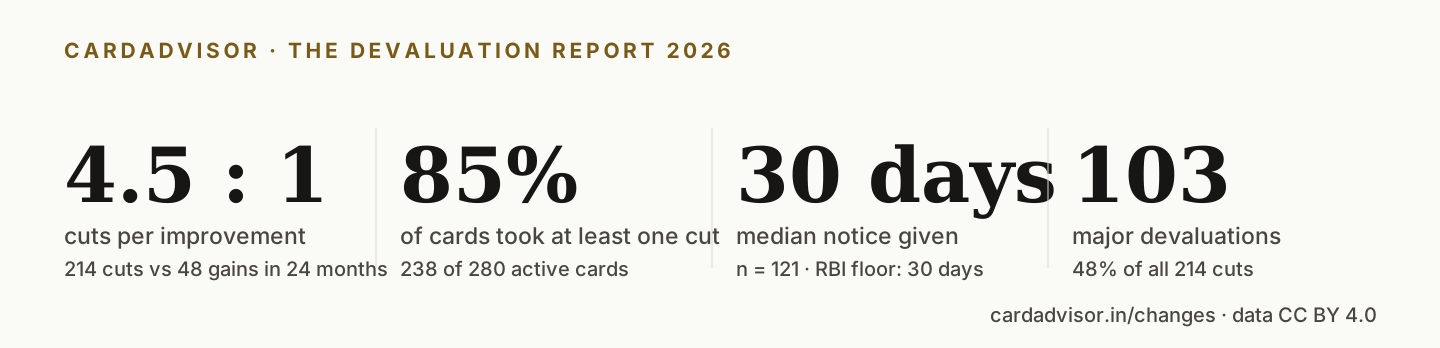
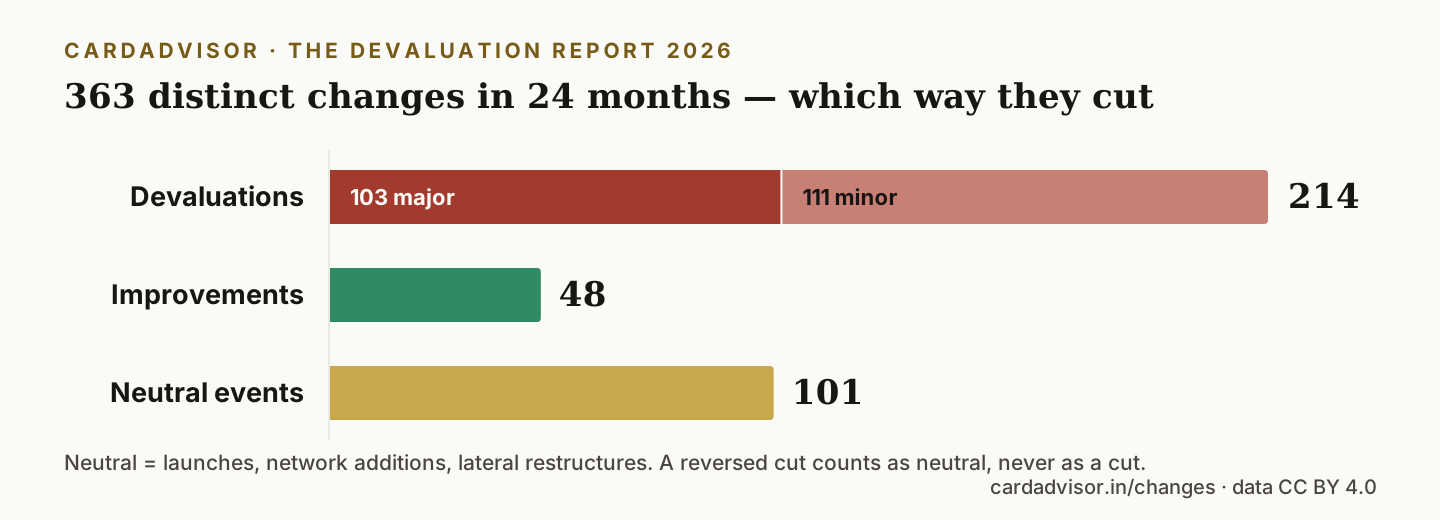
In the last 24 months the record logged 363 distinct changes to active cards. Of those, 214 were devaluations — a reward rate reduced, a fee raised, a redemption capped, a benefit narrowed — against just 48 revaluations that made a card better. The rest were neutral events: launches, network additions, lateral restructures.
That is 4.5 devaluations for every improvement. And the cuts were not cosmetic: 103 of the 214 were major — nearly half — the kind that materially changes what a card returns, not a rounding of terms.
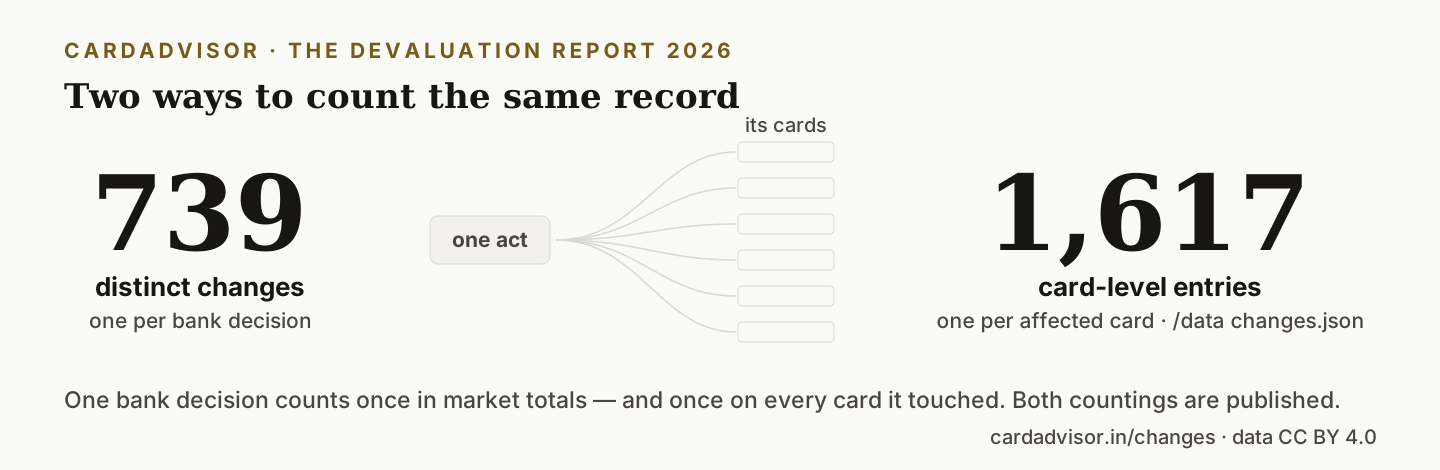
Counted per affected card instead, those 363 decisions landed 995 times on individual card timelines — 790 of them cuts. Both countings are published side by side: this report counts decisions; the open dataset counts effects, one row per affected card.
The direction of travel is not a mystery to anyone who holds a premium card. What the record adds is scale: this is not a few flagship cards making headlines. It is the whole market, moving one way.
More than four in five cards got worse
Devaluation is not concentrated in a handful of unlucky products. 238 of the 280 active cards we track — 85% — took at least one cut in the last 24 months. Include neutral changes and launches, and 98% of cards saw their terms move in some way. Only 7 cards — one in forty — went two full years untouched.
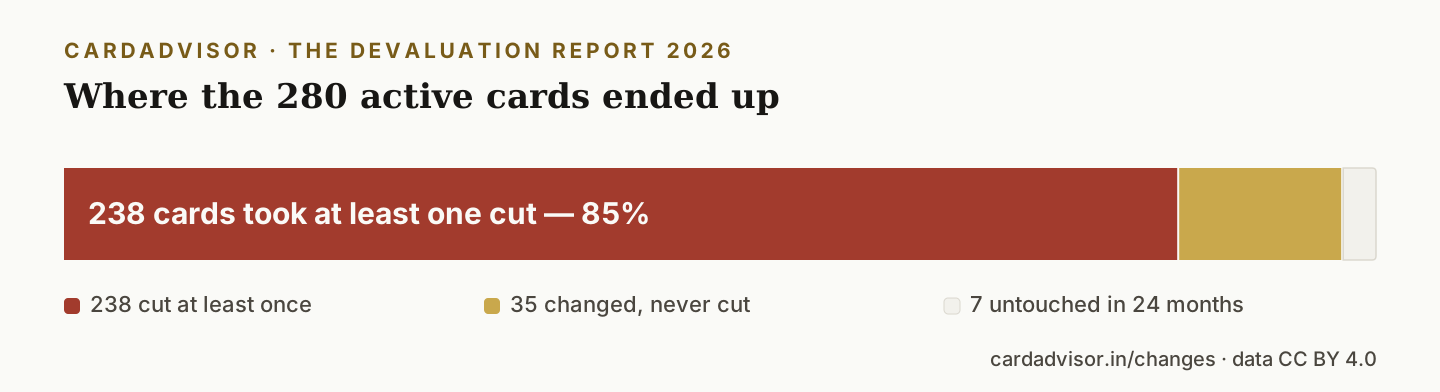
For the cards that did change, the median was 3 changes in 24 months, and the busiest single card logged 12. A credit card, in other words, is not a product you evaluate once. It is a subscription whose terms are rewritten several times a year — usually downward.
What banks cut most: reward earning
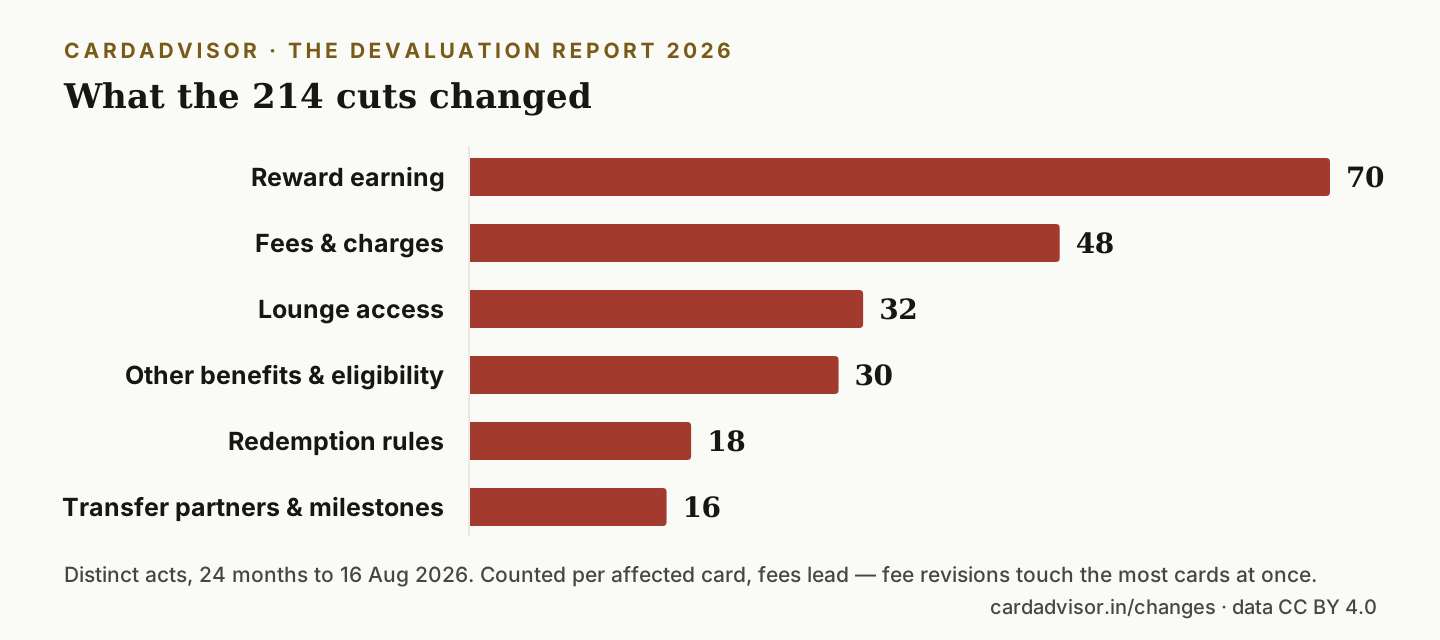
Break the 214 devaluations down by what actually changed, and a clear hierarchy emerges:
| What changed | Devaluations (24 mo) |
|---|---|
| Fees & charges | 48 |
| Reward earning | 70 |
| Redemption rules | 18 |
| Lounge access | 32 |
| Other benefits & eligibility | 30 |
| Transfer partners & milestones | 16 |
Counted as distinct acts, reward-earning cuts lead — 70 in two years, roughly one every ten days. Fees follow at 48, and fee changes are strikingly one-sided: of 62 fee events in the window, 48 made the card more expensive and only 10 made it cheaper. Counted per affected card the order reverses — a fee revision is the change banks most often apply portfolio-wide, so fees touch the most cards at once even though rewards are cut more often.
Redemption deserves a special mention. A card's headline earn rate can survive untouched while a new cap, a redemption fee, or a narrowed catalogue quietly reduces what the points buy. Eighteen such distinct tightenings in two years — several of them bank-wide, applied to every card of an issuer at once — is why we value cards on what a point is actually worth, not on the earn rate alone.
The 30-day warning
For 121 distinct changes in the record, we know both the day the change was announced and the day it took effect. The median gap between the two: 30 days.
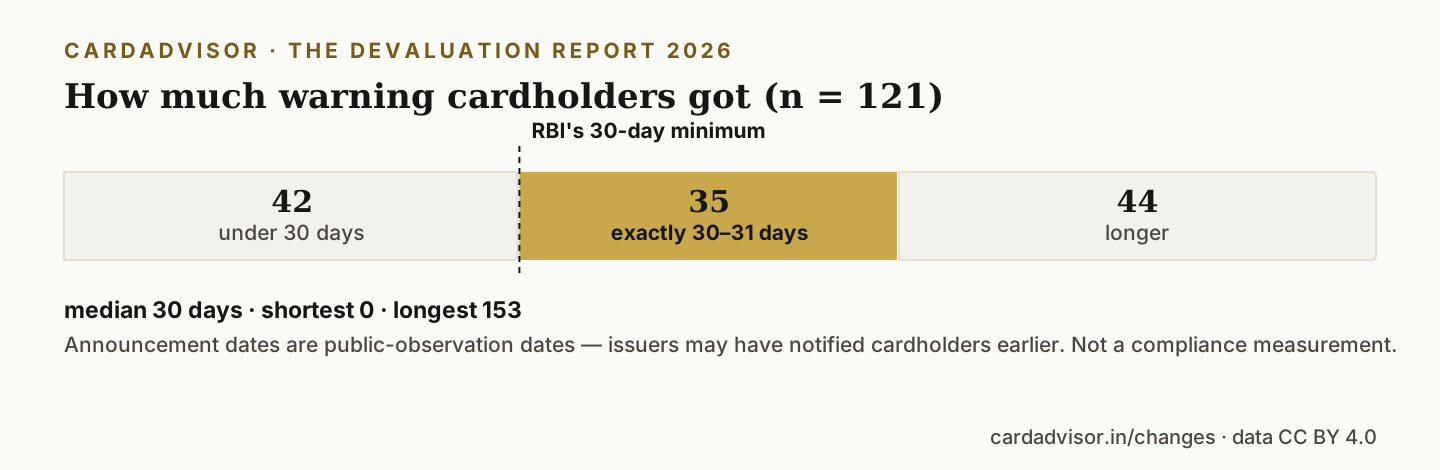
That number is not a coincidence. RBI's card conduct directions state that the terms of a card may be altered, but 30 days' notice of the change shall be given to the cardholder so they can withdraw if they choose — paragraph 79 of the Commercial Banks directions of November 2025, or paragraph 73 of the NBFC set — and issuers cluster almost exactly at that regulatory floor. Few volunteer more warning than they must: the longest notice we recorded was about five months, the shortest was zero days.
One caveat we would rather state than bury: we date an announcement from the day it became publicly observable — a revised document, a notice page, a press item. RBI's clock runs from the day the issuer notified the cardholder through its own channels, which can be earlier. These figures describe what the market announced in public, and are not a measure of compliance.
The same directions give holders a right worth knowing: if a change in charges is to your disadvantage, you may surrender the card without any extra closure charge, subject to clearing your dues. We have written up the notice rule and what our record shows against it in full, and how to escalate when an issuer will not engage. One month is not much time — but it is enough to redeem a points balance before a redemption cut lands, or to decide a fee hike has broken the card's maths. The notice window is usually the only move a cardholder gets, because—
Announced cuts almost never get reversed
Of the 739 distinct changes on our record, exactly 2 were announced and then withdrawn before taking effect. Everything else that was announced, happened.
This is worth internalising, because cardholder forums fill with hope every time a cut is announced — surely the bank will walk it back. The record says: it won't. When a devaluation is announced, the rational response is to act inside the notice window, not to wait it out.
The largest quarter of cuts on our record just happened
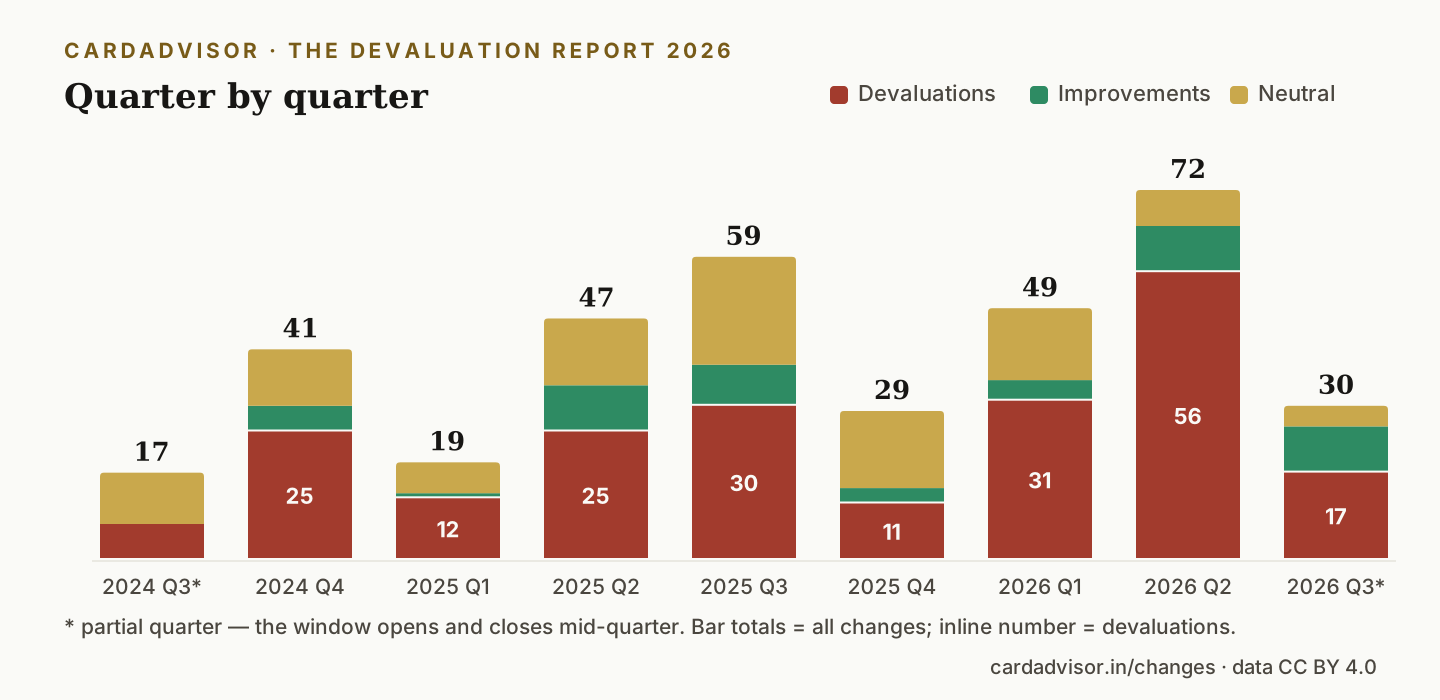
Restricting to the well-observed window, the quarterly rhythm looks like this:
| Quarter | Changes | Devaluations |
|---|---|---|
| 2024 Q3 | 17 | 7 |
| 2024 Q4 | 41 | 25 |
| 2025 Q1 | 19 | 12 |
| 2025 Q2 | 47 | 25 |
| 2025 Q3 | 59 | 30 |
| 2025 Q4 | 29 | 11 |
| 2026 Q1 | 49 | 31 |
| 2026 Q2 | 72 | 56 |
| 2026 Q3 | 30 | 17 |
Two quarters in this table are partial: 2024 Q3 begins where the 24-month window opens on 16 August 2024, and 2026 Q3 runs only to 16 August 2026. Neither is a full quarter, and the 2026 Q3 row is not evidence of a slowdown.
Q2 2026 was the heaviest quarter in our record — 72 distinct changes, 56 of them devaluations, more than 40% above the next-worst quarter on record (2024 Q2, at 39, just before this window opens). The first half of 2026 alone produced 87 devaluations: over 40% of every cut the record logged across the entire two-year window, compressed into six months. Whatever else 2026 is, it is not the year Indian credit cards got more generous.
We will publish this table again each quarter. If the pace changes — in either direction — the record will show it.
Living with a market that changes monthly
This report deliberately stops at description — it names no best card and no worst bank, because a market-level count can't tell you what to hold. What it can tell you is how to behave in a market with these properties:
- Track, don't assume. A card evaluated once and held on autopilot will drift from the terms you signed up for — 85% of cards did in just two years. Every card page on CardAdvisor carries its full dated timeline, the market-wide feed lives at /changes, and /alerts will email you when a card you follow changes.
- Treat the notice window as an action window. Median warning is 30 days, reversals are a rounding error. Announced redemption cut? Redeem first. Announced fee hike that breaks the card for you? RBI rules let you exit without a closure charge.
- Value points at what they buy today. With 18 distinct redemption tightenings in two years — several applied bank-wide — a points balance is a depreciating asset on most cards. A balance you're saving for "someday" is a balance exposed to the next change.
- Re-run the maths yearly. Fee up, waiver up, earn down — any one of them can flip a card from clearly-worth-it to quietly-not. An annual fifteen-minute review, ideally at renewal, is the entire defence.
Methodology — and how to cite this
The underlying record is CardAdvisor's per-card Value Timeline system: for each of the 280 active cards in our catalogue, a dated history of reward, fee, redemption, lounge, transfer, milestone and eligibility changes, each event tagged as a devaluation, revaluation or neutral change, with magnitude, announcement date where known, and at least one source. 74% of the distinct changes in the 24-month window are verified against the issuer's own published documents (product pages, MITC, official notices); the remainder rest on our dated research trail. Events that were announced and then withdrawn are counted as neutral, never as cuts.
One counting rule matters enough to state plainly: a bank-wide revision counts once in this report's market totals, and once per card in its per-card figures. When an issuer changes twenty cards with one decision, that is one act of devaluation — not twenty — so the ratio and the type table count it once; but every one of those twenty cards genuinely got worse, so "cards with at least one cut" counts each of them. On 13 August 2026 we tightened this rule: it had applied only to changes recorded as a single issuer notice, while the same bank decision recorded card-by-card (because its details vary per card) still counted once per card. Every such historical group was audited and keyed, which is why market totals in this edition are lower than in the previous one — the earlier counting overstated bank-wide revisions, by roughly threefold for the most portfolio-happy issuers. Our open dataset publishes the same record the other way — one row per affected card, carrying noticeId/actId group keys, which is why its event count (1,617) is larger than the distinct-change count here (739). Both are correct; they answer different questions.
Counts in this report cover active cards only, use only events dated to at least month precision for windowed figures, and are as of 16 August 2026. The notice figures are narrower still: they rest on the 121 distinct changes carrying both an exact announcement date and an exact effective date, which is a self-selected subset of the record rather than a sample of the market. The record is deepest from 2022 onward; trend comparisons in this report are confined to the recent window where observation is consistent. One honest caveat: a record built card-by-card grows as we find documentation, so lifetime totals will rise over time — which is why we date every figure, regenerate the whole report from the raw record rather than editing numbers by hand, and publish the underlying data.
Aggregates here are deliberately market-level. Per-card histories — every event behind these numbers, with dates and sources — are public on each card's timeline and at /changes.
Cite freely. The event-level dataset is published at /data as JSON and CSV under a CC BY 4.0 licence. Quote any figure with a link back to CardAdvisor; for a specific breakdown behind a story, contact us — the numbers exist and we're happy to share the cut.

I have spent over a decade on Indian credit cards, mostly for the points and miles. I am a software engineer by profession, I hold and use the cards I write about, and I redeem through airline and hotel transfer partners: Avios, KrisFlyer, Flying Blue, Air India Maharaja Club, Accor ALL, Marriott Bonvoy and Taj. What I write about is what a card is actually worth after the fine print, the caps and exclusions that decide the real return, and the changes issuers make quietly. No paid placements.
Frequently asked questions
How often do Indian credit cards get devalued?
How much notice do banks give before a credit card change?
What do banks change most often — fees or rewards?
Do banks ever reverse an announced devaluation?
Can I cite this report?
More guides
Researched from primary sources. How we review →
Independence. CardAdvisor is an independent editorial publication. We are not affiliated with, endorsed by, sponsored by, or authorised to act for any card issuer. All issuer names, product names, and payment-network marks are the property of their respective owners and appear here for identification and comparison only. Card faces shown on this site are our own original illustrations — we do not display or host issuer card artwork or logos.