Last verified: 2 July 2026. Status thresholds, membership prices and transfer ratios are set by Accor and change without notice. Always confirm the live terms on all.accor.com and accorplus.com/in before you buy a membership or chase a tier.
Our Accor ALL transfer guide covers one half of the programme: how Indian bank points flow into Accor (HSBC TravelOne at 1:1, HDFC at 2:1) and why an Accor point is worth a fixed €0.02. This guide is the other half — status and membership. It answers the questions that guide deliberately doesn't: how you actually become Gold, whether the +48% bonus you keep reading about contradicts the "30 nights" threshold (it doesn't), and whether the ₹23,199 AccorPlus membership — or the version your Amex quietly gifts you — is worth it. I'll treat the transfer/valuation material as settled and point back to that guide rather than repeat it.
The short version
- Five earned tiers plus one invite-only tier. Classic (free) → Silver → Gold → Platinum → Diamond, then Limitless above (Accor-selected, not for sale).
- You qualify two ways: nights OR Status points. 10 nights or 2,000 points for Silver, 30 or 7,000 for Gold, 60 or 14,000 for Platinum. Diamond is points-only — 26,000 Status points, unreachable on nights alone.
- The "+24/+48/+76/+100%" you see quoted is not a separate fact from the tiers — it's the ongoing Reward-point earning bonus each tier gives, and it reconciles exactly with the 2.5→5.0 points-per-euro earning rates. One system, stated two ways.
- Status is sticky. Qualify in 2026 and you keep the tier through end-2027; fail to requalify and you drop only one tier, not to Classic.
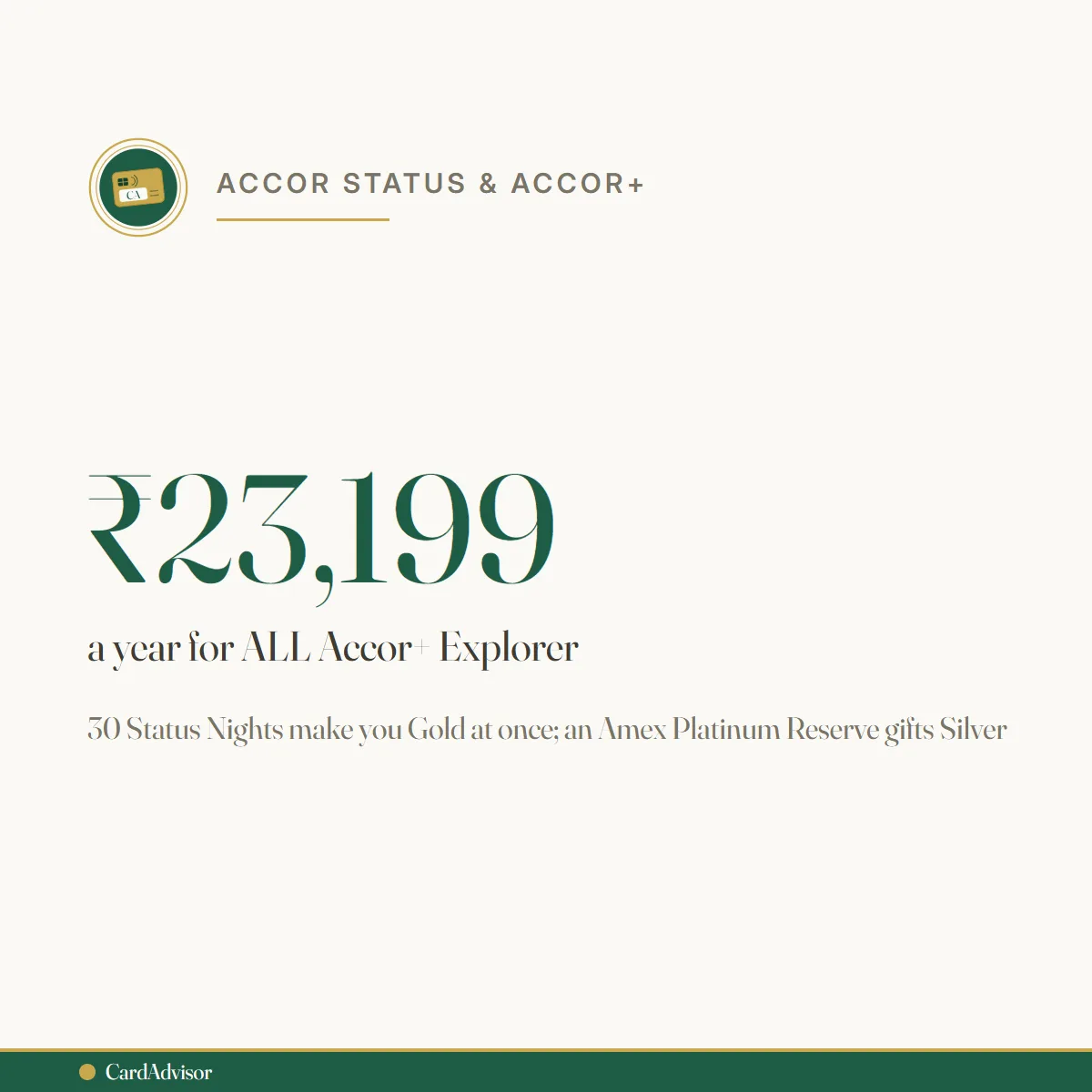
- Two membership products buy status. The paid ALL Accor+ Explorer (₹23,199/year) hands you 30 Status Nights (instant Gold) plus free "Stay Plus" nights. The Amex-gifted version on the Platinum Reserve/Charge gives 20 nights (Silver) and the same discounts, but no free nights.
- Accor points can also feed airlines — Flying Blue at 1:1 is the one route we've verified — with a one-partner-at-a-time 12-month lock. It's rarely the right move: 1:1 here halves your money.
The rest of this guide is the detail.
The five tiers, how you qualify, and what you earn
Here is the whole ladder in one table. The two "qualification" numbers are alternatives — hit either the nights or the Status points and you're in.
| Tier | Qualify: nights or Status points | ~Spend to qualify | Earn rate (pts/€1) | Reward-point bonus vs Classic |
|---|---|---|---|---|
| Classic | Free, automatic on joining | — | 2.5 | Base (0%) |
| Silver | 10 nights or 2,000 pts | ~€800 | 3.1 | +24% |
| Gold | 30 nights or 7,000 pts | ~€2,800 | 3.7 | +48% |
| Platinum | 60 nights or 14,000 pts | ~€5,600 | 4.4 | +76% |
| Diamond | 26,000 pts only (nights can't reach it) | ~€10,400 | 5.0 | +100% |
| Limitless | Invitation-only (not purchasable/earnable) | — | — | +100% |
Source: all.accor.com's official "Benefits and status" page (fetched 2 July 2026), which lists the thresholds and the bonus percentages side by side.
A few rules that matter as much as the numbers:
- Status validity runs long. Whatever you qualify for in a calendar year is held through the end of the following year — reach Gold on stays in 2026 and you're Gold through the end of 2027.
- Soft landing. If you don't requalify, you drop only one tier — a lapsing Diamond becomes Platinum, not Classic. Accor doesn't reset you to zero.
- ibis, ibis Styles and Mama Shelter earn Reward points at 50% of the standard rate. That is a brand-level discount independent of your status — worth knowing if the ibis near the airport is your habitual stay (as it is mine for early departures).
- The non-points perks climb too: Silver adds a welcome drink and late checkout; Gold adds guaranteed availability, a room upgrade and a welcome amenity; Platinum adds Suite Night Upgrades, lounge access, weekend breakfast and a day of Wojo coworking; Diamond adds €100 of annual Dining & Spa Rewards and the ability to gift Gold or Platinum status to one person.
What most guides get wrong: the "+48%" is not a different number from "30 nights"
If you read three Accor explainers you'll come away thinking there are two competing systems — one built on nights, another on mysterious percentages — and you'll wonder which is "real." Both are real, and they describe different moments in the same system.
- The nights/points thresholds answer: "How do I become Gold?" — they're the admission gate. Cross 30 nights or 7,000 Status points and you're admitted.
- The percentages answer: "Now that I'm Gold, how many more Reward points do I earn per euro than a Classic member?" — an ongoing multiplier on every future paid stay.
They reconcile exactly. Base earning is 2.5 Reward points per €1, and the tier bonus produces the tier's absolute earn rate: 2.5 × 1.24 = 3.1 (Silver), × 1.48 = 3.7 (Gold), × 1.76 = 4.4 (Platinum), × 2.00 = 5.0 (Diamond). So the "earning rate" column and the "bonus" column in the table above are the same fact written two ways. There is no second system to learn — ignore any guide that presents the two as if you have to choose between them.
The membership products that hand you status
You don't have to grind 30 nights to reach Gold. Accor sells — and some cards gift — memberships that drop a block of Status Nights straight into your account.
ALL Accor+ Explorer (paid) — ₹23,199/year
This is the paid membership, branded "AccorPlus" historically and "ALL Accor+ Explorer" since the October 2025 relaunch. In India it costs ₹23,199/year including GST (accorplus.com/in, read 8 October 2026); it was ₹19,499 from the October 2025 relaunch until Accor raised the price in 2026. What you get:
- 2 "Stay Plus" nights a year — the free-night mechanic. It's more precisely "pay for 2 nights, get a 3rd free" than a literal buy-one-get-one, across 1,400+ Asia-Pacific and UAE hotels.
- Red Hot Rooms — member-only discounted room rates.
- 30% off dining and 15% off drinks across Asia-Pacific and the UAE.
- 15% off standard published rates at 5,000+ hotels worldwide, year-round.
- 30 bonus Status Nights a year — and 30 nights is exactly the Gold threshold, so this membership makes you Gold instantly.
For a regular Accor guest, the maths is straightforward: if you pay cash at Accor properties several times a year, the Stay Plus free nights and the year-round 15% stack can clear the ₹23,199, and instant Gold is the bonus. At mid-range room rates that takes more than two or three stays, so count yours first.
The card-gifted version (Amex Platinum Reserve / Platinum Charge)
Here's the part worth knowing before you pay ₹23,199: two Amex cards gift you a card-bundled ALL Accor+ Explorer as a benefit.
- The Amex Platinum Reserve (₹10,000 fee, waived at ₹10 lakh spend) grants 20 Status Nights — which clears the 10-night Silver threshold with room to spare (you reach Silver, not Gold), plus the full discount stack: 15% off stays, 30% off dining, 15% off drinks, and Red Hot Rooms access.
- The Amex Platinum Charge (₹66,000 fee) also bundles Accor Plus among its deep elite-status stack (Marriott Bonvoy Gold, Hilton Honors Gold, Taj Epicure and more).
The one crucial difference: the card-gifted version does NOT include the paid membership's free "Stay Plus" nights. You get the discounts and the status nights; you don't get the pay-2-get-3rd-free certificate. That single omission is the honest line between "my card already gives me this" and "I should buy the ₹23,199 membership":
| ALL Accor+ Explorer (paid, ₹23,199) | Amex Platinum Reserve (gifted) | |
|---|---|---|
| Status Nights granted | 30 → instant Gold | 20 → Silver |
| Free "Stay Plus" nights | ✅ 2/year (pay 2, get 3rd free) | ❌ Not included |
| 15% off stays / 30% dining / 15% drinks | ✅ | ✅ |
| Red Hot Rooms | ✅ | ✅ |
| Cost | ₹23,199/year standalone | Bundled in a ₹10,000 card fee |
So: if you hold (or would hold) a Platinum Reserve anyway, you already have Silver and the discounts for free — buy the standalone Explorer only if you specifically want the jump to Gold and the free nights. If you don't hold an Amex, the ₹23,199 Explorer is the direct route to Gold. The card's own data page spells out this exact nuance, so I'm not editorialising here — it's built into how Amex describes the benefit.
A naming caveat, flagged honestly. You'll occasionally see the card-gifted membership called "Accor Traveler." Accor's own page for the Amex benefit calls it "ALL Accor+ Explorer" — the same name as the paid product. "Accor Traveler" is unverifiable as an official Accor brand; it may be Amex's internal shorthand or a label that crept in from elsewhere. The benefit package is confirmed; the name isn't, so I won't use it as if it were official.
The gray-area products: Signature (Brazil) and Accor Plus China
Two more membership routes exist, and points hobbyists talk about them, but I'm flagging both clearly as niche, edge-case geo-arbitrage — not mainstream recommendations for an Indian reader.
- ALL Signature (Brazil). A Brazilian subscription (the "Absolute" tier runs ~R$649/month billed annually) that showers you with points — 5,000 Reward points/month, a 5,000-point bonus every four months, and 1,000 Status points/month. On paper the Status-point drip is a fast lane to a high tier. The catch: it's intended to be sold domestically in Brazil. No geo-block stops a foreign buyer today, which is precisely why it's a known point-hacker tactic rather than an official cross-border product — and that means it carries real risks: you need a Brazil-payable card or a workaround, you're exposed to BRL/INR FX swings, and Accor could close the loophole without notice. The same "programmes change without warning" caveat that saw Axis pull Accor overnight applies here with extra force, because this is explicitly an edge-case.
- Accor Plus China. Sold through Chinese consumer channels (WeChat/Alipay), in two tiers: "Premium" (≈ CNY 1,188 → 20 status nights) and "Suprem" (≈ CNY 2,488 → 30 status nights). Accor has confirmed a 50 status-night cap for China-card-sourced nights specifically — though the same source flags a live rumour that this could revert to 30 after mid-2026, so treat 50 as current but not guaranteed stable. You'll also read that you must buy AccorPlus before the China card for the nights to stack: I could not verify that ordering rule from any source — the one detailed first-hand account admits the author "wasn't told" and only guesses it works — so treat the stacking order as unverified, not fact. The exact rupee prices you'll see quoted (≈₹20k/₹35k) are also unverifiable; the CNY prices and night counts are confirmed, the INR conversions are not.
Both require a foreign payment rail, both sit outside the products Accor intends for an Indian buyer, and Accor's own view on how they stack is ambiguous even to specialist bloggers. If you're already fluent in this kind of points-hacking and go in with eyes open on the FX, payment-access and policy-stability risk, fine — but I would not build a status strategy around either.
Accor points → airlines: the bridge, and when to skip it
Accor points don't only offset hotel stays — you can push them onward to airline programmes. The one ratio we've confirmed:
| Accor → Airline | Ratio | Note |
|---|---|---|
| Flying Blue (Air France-KLM) | 1:1 | In multiples of 2,000 points; one-way — the reverse is a punishing 4:1 |
Accor markets other airline partners, and you'll find confident ratios for them across the internet. We only publish what we can confirm against the programme's own terms, so Flying Blue is the only route in our transfer graph — treat any other Accor→airline number you read as unverified until you've seen it on all.accor.com yourself.
The catch that trips people up: you can only have one airline-transfer partner active at a time. Accor enforces a 12-month lock if you've linked to Flying Blue, Qantas or Azul within the past year. And automatic conversion to Qantas has been suspended since December 2021 — Qantas transfers have to be done manually. So this isn't a currency you can splash across several airlines at will; pick one, commit for a year.
When should you actually do this? Rarely, for most Indian cardholders. Remember from the transfer guide that an Accor point already redeems at a fixed €0.02 (₹2.00 at ₹100/€) of hotel value. To beat that by routing onward to an airline, your airline redemption has to clear more than ₹2 per mile after the 1:1 conversion — and that's the trap in the ratio. A Flying Blue mile is worth roughly half an Accor point, so 1:1 looks like parity and is actually a 50% haircut. Only a specific premium-cabin award that genuinely returns north of ₹2 a mile earns the transfer back. If you just want value, the hotel redemption is usually the simpler, higher-floor play.
If you are going onward, the Flying Blue guide has the redemption sweet spots that make the maths work.
Two perks that need no status at all
Not everything valuable in the Accor ecosystem runs through the loyalty programme. Two revenue-booking mechanics deliver real value with zero status and no Accor account required — worth knowing precisely because they sit outside everything above.
Fora / Accor STEP (formerly HERA) — travel-advisor perks. Book an eligible Accor property through a Fora travel advisor at a STEP-enrolled hotel and the stay can include a US$100 hotel credit (usable toward dining), daily breakfast for two, early check-in / late check-out, and a 3rd-night-free. The honest caveats: all of it is "subject to availability" and property-dependent — not every Accor hotel participates — and because this is a revenue booking, it cannot be combined with a points-funded stay. No status level changes what you get; it's purely a booking channel.
Accor Meeting Planner — for group/corporate events. If you're organising an event (8+ rooms or attendees, catering-with-accommodation counts, catering-only doesn't), the group earns 0.5 Reward points and 0.5 Status points per €1 of eligible spend. The part most write-ups get wrong: the redemption ceiling isn't an open-ended "up to 15% of event cost." Points offset up to 15% of the pre-tax invoice — but capped at a hard maximum of €1,500 per event. For any large booking the €1,500 cap binds long before the 15% does, so don't build a big-event budget around the headline percentage.
So what should an Indian cardholder actually do?
Grounding this in the facts above rather than in any stay of my own:
- If you hold (or would get) an Amex Platinum Reserve, you already have Accor Silver and the full discount stack bundled into the ₹10,000 fee. Don't pay ₹23,199 on top unless you specifically want the jump to Gold and the free "Stay Plus" nights.
- If you're a frequent Accor guest without an Amex, the ₹23,199 ALL Accor+ Explorer is the direct route: instant Gold plus free nights, and a few cash stays a year can pay for it.
- If you mostly want value, not status, skip memberships and focus on the transfer play from the transfer guide — HSBC TravelOne at 1:1 into that fixed €0.02 peg is the highest-floor use of the whole ecosystem.
- Leave the Brazil and China routes to the specialists. They can work, but the FX, payment-rail and policy risk make them a bad fit for anyone who isn't already deep in this hobby.
Disclaimer: status thresholds, earning bonuses, membership prices, transfer ratios and caps are set by Accor and its partners and change frequently, often without notice. Euro- and CNY/BRL-anchored figures convert to rupees only at prevailing FX rates and are approximations, not fixed amounts. The Brazil and China membership routes are edge-case geo-arbitrage carrying FX, payment-access and policy-stability risk — presented for completeness, not as recommendations. Always confirm current terms on all.accor.com and accorplus.com/in before buying a membership or chasing a tier. This guide is independent and informational, not financial advice.

I have spent over a decade on Indian credit cards, mostly for the points and miles. I am a software engineer by profession, I hold and use the cards I write about, and I redeem through airline and hotel transfer partners: Avios, KrisFlyer, Flying Blue, Air India Maharaja Club, Accor ALL, Marriott Bonvoy and Taj. What I write about is what a card is actually worth after the fine print, the caps and exclusions that decide the real return, and the changes issuers make quietly. No paid placements.
Frequently asked questions
How many nights or points do I need for each Accor ALL tier?
What does the +24/+48/+76/+100% bonus mean, and does it contradict the nights thresholds?
How much is the AccorPlus / ALL Accor+ Explorer membership in India?
Which credit cards gift Accor status, and how much?
Can I transfer Accor points to airlines?
More guides
Researched from primary sources. How we review →
Independence. CardAdvisor is an independent editorial publication. We are not affiliated with, endorsed by, sponsored by, or authorised to act for American Express and HSBC. All issuer names, product names, and payment-network marks are the property of their respective owners and appear here for identification and comparison only. Card faces shown on this site are our own original illustrations — we do not display or host issuer card artwork or logos.