
The trip, in one line: four nights at ibis Jaipur — about ₹14,500 for the stay (breakfast included), plus the odd bit of food I charged to the room, settled entirely with 7,000 Accor points and ₹0 cash. This is the story of how, plus the front-desk tricks that made it possible.
Every points blog you've ever read is about the same thing: the suite upgrade, the butler, the lounge with the unlimited Veuve, the "I flew first class for the price of a samosa" flex. I've done plenty of that, and I'll write about it too. But here's the honest truth nobody in this hobby likes to say out loud:
Premium isn't always the smart play.
Sometimes you're not travelling to be pampered. You're travelling to work — to sit in a quiet room with a strong Wi-Fi signal, finish what you came to finish, sleep, and leave. On a trip like that, a ₹40,000-a-night palace and a 90,000-point redemption isn't a flex. It's a leak. You're paying — in cash or in points, doesn't matter — for marble you'll walk past at 6 a.m. on your way to a meeting.
So this article is the anti-flex. It's about the most economical Accor redemption I've ever pulled off in India — and, quietly, one of the most satisfying, because it exposed a few things about how Accor ALL really works that the app will never tell you. I've stayed in Accor hotels for years, all the way up the ladder. This was the cheapest. It might also be the one I'm proudest of.
And although I'll use this one ibis stay as the worked example, the playbook is the point — the Flexible-rate booking, the 1,000-point front-desk increments, the food-on-the-folio trick — and every move here works at any Accor property in India, from an ibis to a Sofitel. This is really a guide to paying a whole hotel bill with Accor points, told through one real, documented stay: ibis Jaipur City Centre, late January 2026, with every figure taken straight from my own Accor ALL account statement — the actual screenshot is further down, so you can check my working, not just take my word for it.
Let's get into it.
Why I deliberately booked the cheapest hotel in the Accor family
There's a snobbery in this hobby about ibis. "It's the budget one." Correct — and that is exactly the point.
ibis is Accor's premium-economy brand: the bottom rung of a group whose top rungs are Sofitel, Pullman and Raffles. In India it is, on most days, the cheapest All-Accor brand you'll find (rates float with demand, but ibis almost always sits at the floor). And for a work trip, "the cheapest one in a chain I trust" is not a compromise — it's the brief.
I went in with my expectations set to ankle height. Which is the secret to a happy hotel stay, by the way: book the budget brand, expect a clean bed and a working shower, and let everything above that be a pleasant surprise.
For the record, ibis Jaipur City Centre is the Civil Lines property — around 160 rooms, a 4-star fit-out on a premium-economy budget, with Civil Lines metro station roughly 250 metres away (you can walk it), an on-site restaurant, a gym, a rooftop pool, and Wi-Fi that actually held up to a video call. It is built for exactly the trip I was on: show up, work, sleep, leave, repeat.
Now the fun part — the money. Or rather, the lack of it.
First, the boring-but-vital bit: how Accor points actually work
If you skip this section, the rest won't land, so stay with me for ninety seconds.
Accor ALL (Live Limitless) points are not like airline miles. There is no award chart, no "this hotel costs X points a night," no peak/off-peak, no blackout dates. Instead, Accor points are a fixed-value currency:
- 2,000 points = about £40. That's roughly £0.02 per point, flat.
- You use them to offset the cash price of a stay — part of it or all of it.
- The rupee value floats with the exchange rate. On the day I redeemed, the pound was ₹107.86, so:
1 Accor point ≈ ₹2.157 that day — and 2,000 points ≈ ₹4,314.
(Accor quotes this peg in euros on its website — €40 per 2,000 points — but my ALL account settles in pounds, so that's the currency you'll see me use here. Either way the key fact is the same: a point is pegged to a foreign currency, which matters more than you'd think — I'll come back to it.)
That ₹2.16-ish per point is a strong number for a hotel currency — often better than what you'd squeeze out of a domestic economy flight redemption. (If you want the full mechanics, and the Indian credit cards that feed Accor points, I've written it all up separately in the Accor ALL points transfer guide. The one-line version: HSBC TravelOne transfers at 1:1, and HDFC's premium cards at 2:1.)
Two things to file away, because they're the hinges this whole story turns on:
- Online — the app and all.accor.com — you can only redeem in 2,000-point blocks. 2,000, 4,000, 6,000… nothing in between. There is no "use 5,000 points" button.
- You can't overshoot the bill — so there's never any "change." Online you step points up one 2,000-block at a time, but the next block is disabled the instant it would exceed your bill. Say the bill is ₹10,564: 4,000 points (₹8,629) is allowed, but 6,000 (₹12,943) would blow past it, so the app simply won't offer it — you stop at 4,000 and pay the ₹1,935 rest in cash. Nothing is ever lost. But notice the catch: the bigger your bill, the more points you're allowed to use — which turns out to be the whole checkout trick.
Remember both. They're about to matter a lot.
Why I chose the Flexible rate (and why it's secretly the smart-money move)
I booked three nights to start — this was late January 2026 — on the Flexible rate, breakfast included. The quote:
₹10,564.63 for three nights.
Now, the Flexible rate is always a few rupees more than the cheap, non-refundable "Saver" rate, and every instinct screams pay less. Ignore that instinct. Here's why the few extra bucks are some of the best money — sorry, points — I've ever spent:
1. Free cancellation until 12:00 noon, the day before check-in. Zero cost. And here's the move nobody talks about: if the rate drops after you book — and hotel rates bounce around like a cricket score — you just cancel and rebook at the lower price. No one at Accor calls to ask why. You can do it five times if you like. It's a free option on the price of your own room, and you'd be amazed how often it pays.
2. No cash, ever — and you can pay in points in two bites. A Flexible booking lets you settle the whole thing in points without a rupee of cash: I put 4,000 points against the room when I booked the three nights online (26 January), then cleared the rest at the front desk on the way out. Why does splitting it matter? Because online and the front desk play by completely different rules — and the gap between them is exactly where the value hides. Hold that thought.
Walking in: what "the cheapest one" actually gets you
Check-in was on time and quietly competent — no theatre, no fuss, exactly what you want when the goal is to not think about the hotel. And then the stay proceeded to over-deliver, precisely because I'd asked it for so little.
The room was clean, cool, and — the thing I actually came for — silent. The location does a lot of heavy lifting: metro on the doorstep, the usual Jaipur essentials within reach (though, fair, half the hotels in Jaipur can say that). I got my work done. I slept. Nobody disturbed me. For this trip, that was a 10/10.
A word on food — and an honest one, because I don't want to oversell this. I was out most of the day, every day, so I barely used the hotel kitchen: breakfast came bundled with the rate, and beyond that it was one dinner and, right at the end, some food packed for the road. The restaurant most ibis (and a lot of All-Accor) properties run is called Spice It — multi-cuisine, genuinely decent, though priced a notch above what you'd expect at this level. But here's the bit worth remembering: whatever food you do put on your room folio can be paid with points. Which is exactly why that one dinner, and the packed lunch, cost me ₹0 in cash. More on that at checkout.
The plot twist: extend at the desk, not on the app
Three nights in, my plans shifted and I wanted a fourth night.
Naturally, I opened the app to extend. And here's lesson one of the day: on the app, a fourth night isn't an "extension" — it's a brand-new booking. Which means a new reservation, and the joy of doing check-in formalities all over again for a room I was already standing in.
So I did the radically old-fashioned thing. I walked up to the reception and asked.
Two surprises:
- Their rate for the extra night was lower than what the app was showing me. Same hotel, same night, cheaper at the desk. Read that twice.
- They simply extended the existing stay — one continuous reservation, no second check-in, no drama.
Talk. To. Humans. The app is a vending machine; the front desk is a person with discretion. This is a recurring theme in hospitality and most people never test it.
Checkout: how 7,000 points cleared the bill — and I still packed lunch
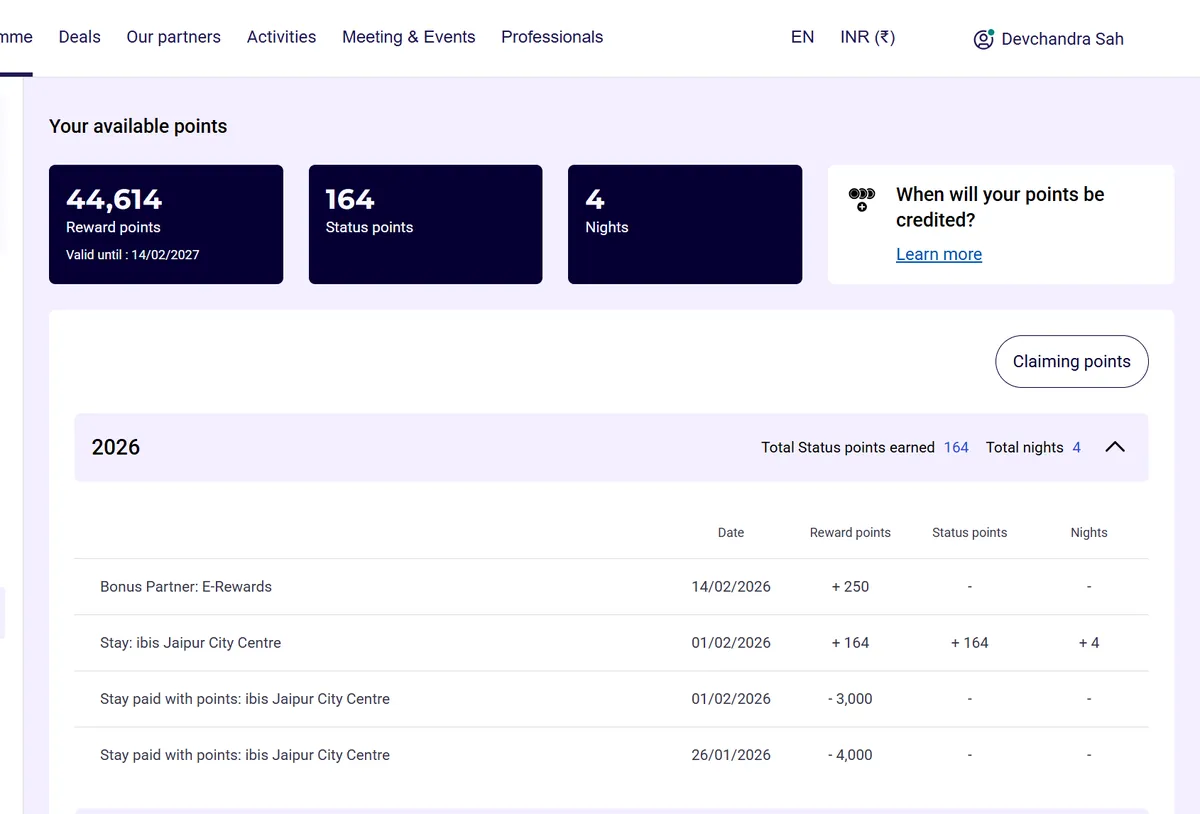
This is the part I'd frame and hang on a wall — and you don't have to take my word for any of it, because it's straight off my ALL account statement (screenshot below).
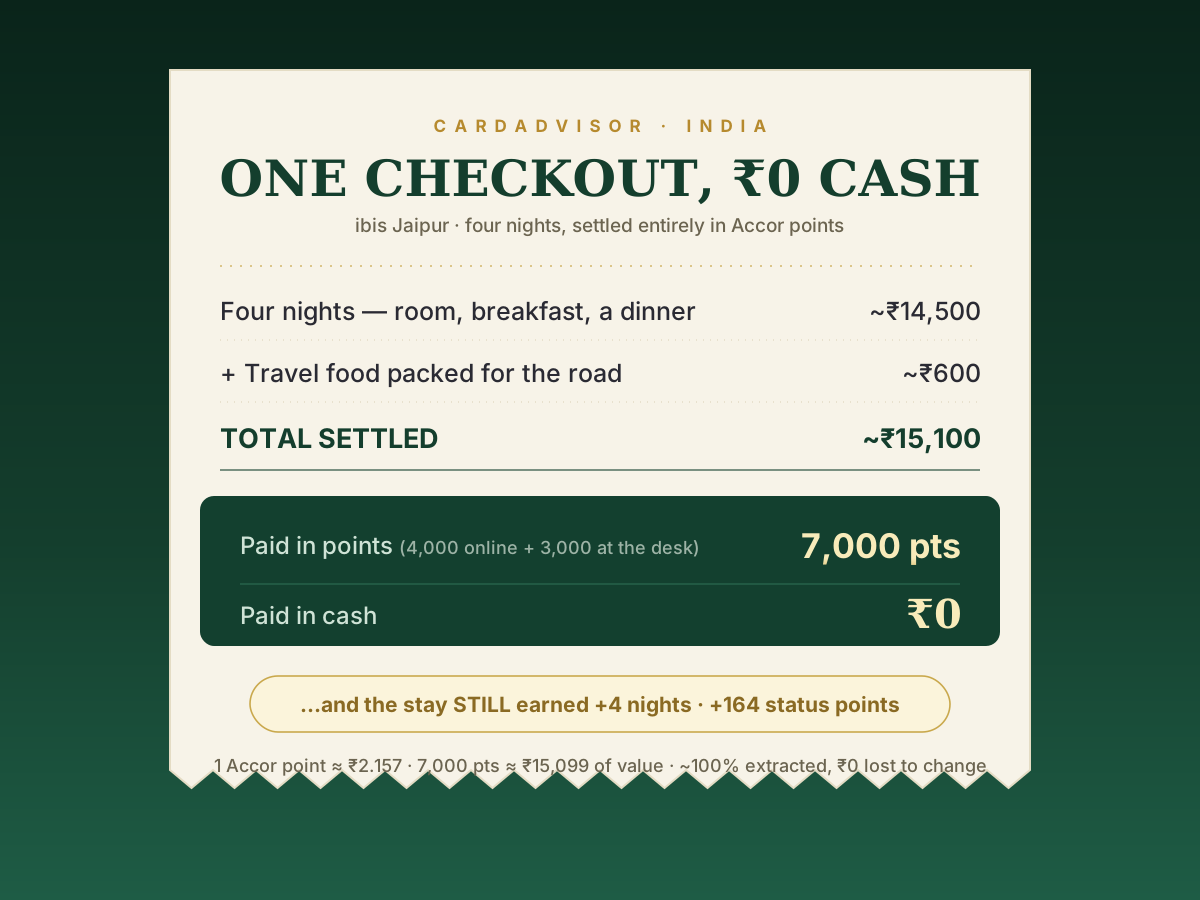
By checkout, four nights — breakfast in the rate, plus the one dinner and the odds and ends I'd charged to the room — had added up to a folio of roughly ₹14,500. I cleared it in points, in two moves — and the difference between the two moves is the lesson.
Move 1 — at booking, online: 4,000 points. When I booked the three nights online on 26 January, I paid 4,000 points on the spot. Note the round number — online, points only move in 2,000-point slabs (2,000, 4,000, 6,000, nothing in between), and 4,000 was the most I could apply without blowing past the ₹10,564.63 quote. 4,000 points = £80 ≈ ₹8,629, leaving about ₹1,935 of the three-night cost to mop up at checkout.
Move 2 — at the front desk, at checkout: 3,000 points. Here's the trick the app will never show you. At the desk, my property let me redeem in 1,000-point increments — so I settled the rest with 3,000 points (≈ ₹6,471). Read that number again: 3,000 is impossible to pick online — it lives in the gap between the 2,000 and 4,000 slabs. The only reason that line exists on my statement is that I did it at the reception. That single row is the proof of this whole article.
By checkout I'd added the fourth night and the few F&B charges I'd put on the room, so — after the 4,000 points already paid at booking — the balance was about ₹5,871. Here's where that cap from earlier bites: the biggest block that fits under ₹5,871 is 2,000 points (₹4,314), which would leave ₹1,557 to settle in cash. To clear that in points too, I needed the bill to land on a higher clean block — so I got mischievous.
The folio trick: food on the room is point-eligible — and it lifts the cap. Points offset your whole folio, not just the room line — restaurant, that one slightly-too-proud Spice It dinner, room service, all of it. So I asked the desk to pack ₹600 of food for my journey home and put it on the bill. That lifted the checkout balance to exactly ₹6,471 — a clean 3,000-point block — so the system let me apply all 3,000 points and the cash due dropped to ₹0. The ₹1,557 I'd otherwise have paid in cash left the hotel with me as lunch instead.
| Line | Amount |
|---|---|
| Four nights, room folio (breakfast incl. + one dinner) | ~₹14,500 |
| + Travel food packed onto the bill | ~₹600 |
| Total settled | ~₹15,100 |
| Paid in points — 4,000 online + 3,000 at the desk | 7,000 points |
| Paid in cash | ₹0 |
Final bill: 7,000 Accor points. Zero rupees. Four nights, plus the handful of F&B charges I'd put on the room and the packed lunch for the road — not a single rupee out of pocket.
The bit most guides get wrong: the stay still counted
Now look back at that statement, at the one line that isn't a redemption. The same stay credited:
- +4 qualifying nights
- +164 Status points
- +164 Reward points back into my balance
So I spent 7,000 points and the stay still nudged me toward my next tier. Most guides will tell you a points stay is "dead" for status — that it earns nothing. Mine didn't, and here's the distinction almost nobody spells out: I booked an ordinary paid (Flexible) rate and paid it down with points — which is not the same as booking a dedicated "Reward night" award. Qualifying nights accrue no matter how you pay, and on a paid rate the status points tagged along too. A pure reward-night award would have earned me none of it. Same points out the door — but this way, I kept climbing.
The hidden Accor tricks nobody puts in the brochure
If you remember nothing else, remember these six. This is the actual value of the article.
- Book the Flexible rate, not the cheapest Saver. Free cancellation until noon the day before means you can re-book every time the rate drops — a free option on your own room — and you pay nothing upfront, which sets up everything below.
- Redeem at the front desk, not online. Online forces 2,000-point blocks; the desk often allows 1,000-point increments — so the largest block that fits under your bill leaves a much smaller cash remainder.
- Food on the room folio is point-eligible — and it can unlock more points. Because points can only be applied up to your bill, adding a little F&B (a dinner, or food packed for the road) lifts the total just enough for one more block to fit — turning what would've been a cash remainder into points. That's how my packed lunch ended up paid in points.
- Extend at the reception, not the app. The app makes a fourth night a new booking (and a second check-in). The desk extends the stay — and quoted me a lower rate than the app.
- For a work trip, the cheapest brand is the right brand. ibis gives you clean, quiet and predictable. Spending more points for luxury you'll sleep through is the one redemption that's never worth it.
- *Pay a paid rate with points — not a "Reward night" award. Book a normal cash rate and settle it with points, and the stay still banks your qualifying nights* (and, on mine, 164 status points too). A dedicated reward-night award earns you none of that. Same points out — but one of them keeps you climbing toward status.
So… was it worth it? The honest maths
Let's value what I actually got. 7,000 points at ₹2.157 each is about:
7,000 × ₹2.157 ≈ ₹15,099 of value — almost precisely the ₹15,100 I settled. So I extracted essentially 100% of the points' worth, with ₹0 cash and not a single point wasted.
Could those same 7,000 points have bought a single decadent night somewhere with a chandelier? Probably. But that's the trap I opened this piece with. Four useful, quiet, productive nights — a clean bed, the included breakfast, a good night's sleep — beat one night of marble I'd have barely seen. Same points, four times the actual utility.
The quiet kicker: the same points keep buying more
Here's something it took me years to properly clock. Because each point is pegged to a foreign currency — pounds, in my account — its rupee value isn't actually fixed at all. It tracks the exchange rate, and the rupee has been drifting weaker for years.
- A few years ago, with the pound lower against the rupee, an Accor point was worth roughly ₹1.8.
- On my ibis redemption day, pound at ₹107.86, the same point was worth ₹2.157.
I didn't earn "better" points. The points didn't change. The rupee did. The exact same 2,000-point block buys meaningfully more hotel today than it did a year or two ago — my balance quietly grew in value while it just sat there. In that narrow sense an Accor stash behaves like a small, boring, hotel-shaped hedge against a softening rupee: you're holding a hard-currency peg, and your buying power drifts up. It's not a reason to hoard — idle points earn nothing, and the rate can swing the other way — but it's a real, under-appreciated tailwind for anyone who actually spends Accor points in India.
The honest caveats, because credibility is the whole point of this site:
- The ₹2.157/point figure is a ceiling — it only counts because I'd genuinely have paid that cash rate for these nights. Points spent on a room you wouldn't otherwise book aren't "value," they're a purchase you talked yourself into.
- It still counted toward status — but don't over-assume. Because I booked a paid rate and paid it down with points (not a reward-night award), the stay still credited 4 qualifying nights and 164 status points. Qualifying nights accrue however you pay; the reward/status points track the eligible portion, so a points-heavy stay won't always earn much — but the nights are yours regardless.
- Your rupee value rides the pound. It's been a tailwind lately (more rupees per point than a year ago), but a stronger rupee would quietly cut the other way — this is a peg, not a promise.
- Programmes change. Increment rules and front-desk flexibility can vary by property and over time — so confirm the 1,000-point option at your desk before you count on it.
Who should copy this (and who shouldn't)
Copy it if: you travel for work or quiet, you sit on a stash of Accor points (or hold a card that feeds them — see below), and you'd rather stretch points across many sensible nights than blow them on one Instagram night.
Skip it if: the experience is the point of the trip — the suite, the spa, the view. For that, go premium and enjoy every rupee of it. Different tool, different job. Just don't kid yourself that a work trip needs it.
If you don't have the points yet, the cheapest way for an Indian cardholder to build an Accor balance is to funnel a transferable-points card into ALL. The short version: HSBC TravelOne transfers at a market-best 1:1, and HDFC Infinia (and its premium siblings) at 2:1 — though the Infinia is invitation-only, so for most people the practical HDFC route is the Diners Club Black or the Regalia Gold at the same 2:1. I've laid out every route, ratio and cap in the Accor ALL transfer guide — and if hotels are your thing generally, the best travel credit cards round-up is the place to start.
The full Accor ALL series
This is the on-the-ground, receipts-and-all chapter. Read as a set, in the order most people need them:
- How Accor ALL points really work — the mechanics: why a point holds ~₹2, how reward nights price, and the desk tricks.
- Accor ALL points transfer guide — which Indian cards feed Accor, and at what ratio (HSBC 1:1, HDFC 2:1).
- The ibis Jaipur redemption (you're here) — a real stay, ₹0 cash, receipts and all.
- Accor ALL status & AccorPlus — the tiers, and how status lifts your earning rate.
Written from my own stay. Figures reflect the rates on my redemption day (pound at ₹107.86, so ≈ ₹2.157 per Accor point) and Accor's fixed foreign-currency peg (about £0.02 a point in my account); your rupee value will move with the exchange rate. Front-desk increment rules and rates vary by property and over time — always confirm at your own reception. Independent and informational, not financial advice — and definitely not sponsored by the kitchen that packed my lunch.

I have spent over a decade on Indian credit cards, mostly for the points and miles. I am a software engineer by profession, I hold and use the cards I write about, and I redeem through airline and hotel transfer partners: Avios, KrisFlyer, Flying Blue, Air India Maharaja Club, Accor ALL, Marriott Bonvoy and Taj. What I write about is what a card is actually worth after the fine print, the caps and exclusions that decide the real return, and the changes issuers make quietly. No paid placements.
Frequently asked questions
Can you pay an entire Accor hotel bill with points?
How much is one Accor point worth in India?
Can you use Accor points for food and restaurant bills?
What is the minimum Accor points redemption?
Is ibis Jaipur City Centre good for a work trip?
Is it cheaper to extend a hotel stay at the reception or on the app?
More guides
Researched from primary sources. How we review →
Independence. CardAdvisor is an independent editorial publication. We are not affiliated with, endorsed by, sponsored by, or authorised to act for HSBC and HDFC Bank. All issuer names, product names, and payment-network marks are the property of their respective owners and appear here for identification and comparison only. Card faces shown on this site are our own original illustrations — we do not display or host issuer card artwork or logos.