
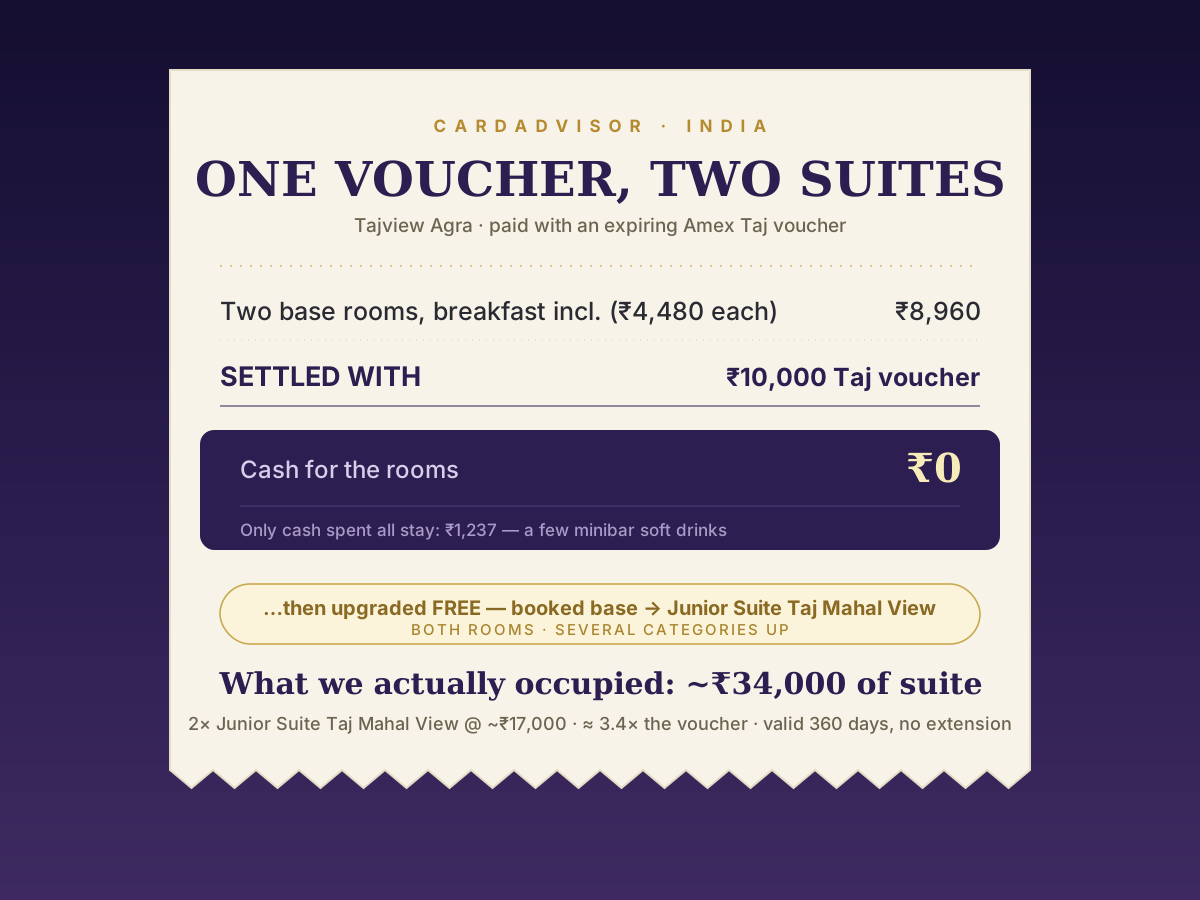
The trip, in one line: two base rooms at Tajview Agra, booked for ₹8,960 and paid with a ₹10,000 Amex Taj voucher that was days from expiring — then upgraded, both rooms, to a Junior Suite Taj Mahal View that was selling for ₹17,000 a night each. Premium in reality. The voucher covered every rupee of the rooms; the only cash that left my pocket was ₹1,237 — and that was for the soft drinks, not the suite.
A little while ago I wrote about the cheapest Accor stay I'd ever pulled off in India — four quiet nights at an ibis, the whole bill cleared in points, ₹0 cash. The whole point of that piece was the anti-flex: premium isn't always the smart play, and a budget room you'll actually use beats marble you'll sleep through.
This article is the exact mirror image. Because sometimes premium is the smart play — when the premium part costs you almost nothing.
Two weeks ago I took my family to Agra and we stayed in a Taj-Mahal-view suite at Tajview Agra. The real thing: marble lobby, the monument framed in the window, the kind of stay that ends up on the family WhatsApp group for a month. And the cash that left my pocket for the rooms was, near enough, zero — the whole thing was built on a voucher I'd already earned and was about to lose. The only actual money I spent across the entire stay was ₹1,237 — and it wasn't for the rooms at all; it was the soft drinks we drank in the room. Hold that number; it's the punchline.
This is the story of how, and — more usefully — the small, deeply unglamorous booking decisions that turned a ₹10,000 voucher into ₹34,000 of stay. None of them are secrets. All of them are things most people get exactly backwards.
Let's get into it.
The currency: a melting ice cube, not a savings account
In the Accor piece, the hero was a points balance that quietly gains value over time — a hard-currency peg you could happily sit on. This story runs on the opposite kind of asset, and the contrast is the whole lesson.
I carry the American Express Platinum Travel Credit Card. The version I held threw off, once I crossed a spending milestone in a membership year, a clutch of Membership Rewards points plus a ₹10,000 Taj voucher — formally a Taj Experiences e-Gift Card, usable across Taj, SeleQtions and Vivanta hotels. For someone who travels and redeems through hotels, that voucher is one of the most genuinely useful milestone benefits any Indian card hands out: no portal pricing, no transfer ratio, no devaluation roulette. ₹10,000 of Taj is ₹10,000 of Taj.
With one catch that changes everything: it's valid for 360 days, and Taj will not extend it. Ever.
That's not a savings account. That's a melting ice cube. A points balance rewards patience; a voucher punishes it. The day it expires, its value doesn't drift down — it goes to zero, instantly, and you've effectively handed the spend that earned it back to the bank for free. So the entire game with a Taj voucher is the reverse of the points game: don't optimise, don't wait for the perfect trip — just use it, and use it where each rupee of voucher buys the most hotel.
Mine was due to expire on 27 June. Which is the real reason this trip happened at all. I didn't go to Agra and then think about the voucher; the voucher's clock decided we were going to Agra.
One honest footnote for anyone chasing this benefit today: Amex restructured these milestones in March 2026, and the Taj voucher now sits behind a higher ₹7 lakh of annual spend than it used to. It changes again on 10 September 2026 — the voucher doubles to ₹20,000, but the 22,500 Membership Rewards points that used to arrive with it are dropped, so the ₹7 lakh milestone becomes a Taj-only reward. If you'd have spent that ₹20,000 at Taj anyway, you come out ahead; if you were transferring those points to Marriott or KrisFlyer, you don't. I've laid out the new maths in my Amex Platinum Travel review. This piece is about spending the voucher well, whatever milestone you earned it at.
Decision one: I booked the cheapest room on purpose
Here's the move almost everyone fumbles. You've got a Taj voucher and a Taj-Mahal-view hotel in front of you, so the temptation is to book up — pick the suite, live a little.
Don't. I booked the base category room, and I did it deliberately, for two cold reasons:
- A voucher stretches furthest at the bottom of the menu. ₹10,000 against a ₹5,000-a-night base room is two comfortable nights, or two rooms for one night — real, usable stay. ₹10,000 against a ₹30,000 suite is a third of one night and a large cash top-up. Same voucher, wildly different mileage.
- You can only be upgraded if there's room above you. This is the part people forget. Book the top suite and you've capped yourself — there's nothing left to be bumped into. Book the floor and you leave the hotel a whole ladder of ways to delight you for free.
I'm an average-value traveller at heart: I don't like burning cash — or vouchers — on hotel categories I'm asleep in for most of the hours I'm paying for. This was a one-night family run to Agra — we drove down from Delhi to show the kids the Taj and drove back — so I booked two base rooms for the night (we needed two), breakfast included, at ₹4,480 a room — on a package the hotel had cheerfully named "Make Your First Memorable." Call it ₹8,960 — comfortably inside the ₹10,000 voucher. The plan was simple: clean rooms, the kids comfortable, the monument nearby, voucher used before it died. Expectations set sensibly low. Which, as in the Accor piece, is the actual secret to a happy hotel stay.
What happened next is why I'm writing this.
Decision two: I called the travel desk — and never touched the app
You cannot apply an Amex Taj voucher through a normal online booking the way you'd punch in a card. So I did the thing the app generation has forgotten how to do: I picked up the phone.
Here's how a voucher booking actually goes, start to finish, because nobody documents this clearly:
- I checked the price and dates myself first — on the official Taj site and the Tata Neu app — so I knew what a fair rate looked like and wasn't negotiating blind.
- Then I called the Taj travel desk and let them book it. They walked me through the whole thing and — this is the part that surprised me — *their rate came in lower than what the website and the app were showing for the same room, same date. The desk wasn't just the only way to use a voucher; it was the cheapest* channel, full stop.
- They asked about us, not just the dates. Early check-in? Late checkout? Any occasion? Purpose of travel? It doesn't feel like a script — it feels like a team genuinely trying to work out how to make the trip land. (Answer their questions properly. This matters later.)
- I told them up front I'd be paying with a voucher, and where it came from — "this is the Amex Platinum Travel Taj voucher." Saying that early avoids a tangle at payment; they know exactly what they're dealing with.
- After the call, they emailed a payment link. I was told to simply reply confirming I'd be settling with the voucher rather than paying the link — so I did. That reply is what locks the booking. Done. Confirmed.
And one quiet, valuable detail: I'm a Silver member, and those benefits were honoured even though I'd booked through the desk rather than online. Getting into the programme costs nothing — NeuPass / Taj InnerCircle is free to join on the Tata Neu app, and you're onboarded at the base member tier the instant you sign up. Silver is the first rung you actually earn — ₹1 lakh of eligible hotel spend, or ten nights, in a year — and it's the one that starts unlocking the good stuff: room upgrades, dining discounts and the like. So the lesson isn't "everyone's a Silver" (you're not, until you've put in the nights). It's this: whatever tier you hold, get your membership number onto the booking — yes, even by phone — because status is a genuine input into who the hotel chooses to upgrade. Don't leave it off the file just because you didn't book online.
So before I'd even left Delhi, three decisions were quietly stacked in my favour: a base room with upgrade headroom, a desk rate below the app, and a loyalty number on the file. Now the trip.
Walking in: a fully-booked hotel, an apology, and a kids' zone
Agra is a short hop from Delhi, so we drove down and I'd asked for early check-in. We rolled up around 1 p.m.
Now, lesson three, and it's a mindset more than a trick: *early check-in and late checkout are always subject to availability. They are a courtesy, not a clause. The previous night the hotel had been fully booked — every room occupied — so an early room simply wasn't ready, and there was nothing anyone could do to conjure one. What struck me was how they handled it: the staff were genuinely apologetic, almost more bothered by it than I was, and they made sure we were comfortable while the rooms turned over. The kids disappeared into the kids' zone*, we had some refreshments, and honestly the hour evaporated. If you travel with children, file that away: a good hotel's ability to absorb a delay gracefully is worth more than the half-hour you "lost."
It took the usual while for the rooms and the check-in formalities, and at about 2:10 p.m. the receptionist came over. She apologised again for the wait — and then said they had a little surprise for us.
The reveal: both rooms, several rungs up the ladder
Let me set the stage before the reveal, because the numbers are the point.
I had booked the base category — ₹4,480-a-night rooms. The category ladder at Tajview Agra runs Executive Rooms → Junior Suites → SeleQtions Suites, so I was sitting at the very bottom with a lot of building above me.
The surprise: they'd upgraded us to a Junior Suite Taj Mahal View, King Bed — and not one room as a goodwill gesture, but both of our rooms. Notice how it was done, too: the receptionist didn't just slide two keys across the counter and point at a lift. She walked us through what they'd arranged and why, the apology for the wait folding seamlessly into the good news. I'm used to getting a level of upgrade now and then. This was several rungs in one jump, doubled.
And the upgrade wasn't the end of it. When we got upstairs there was a welcome touch waiting in the suite — the small, considered kind of gesture that tells you a hotel has actually thought about you rather than ticked a box. After a delayed, slightly chaotic arrival with two kids in tow, walking into that did something no marble lobby on its own can: it made the whole family feel genuinely looked after. That is what you're really buying at a Taj — not the thread count, the judgement of the people running the place.
I'd checked that exact suite's price for our dates while booking, so I knew precisely what had just landed in our laps: around ₹17,000 a night.
So sit with the arithmetic for a second. I'd booked ₹4,480 rooms. We were handed ₹17,000 suites — the kind with the monument itself framed in the window, which is the entire reason you come to this hotel and not a generic one across town. Two of them. (And on the booking that shows in my Tata Neu account, the category reads "Junior Suite Taj Mahal View King Bed" — at the ₹4,480 package price. The upgrade, in black and white.)
The honest maths: ₹10,000 became ₹34,000
Let's value what actually happened, the way I value every redemption on this site — and this time you don't have to take my word for a single rupee, because here's the actual checkout folio:
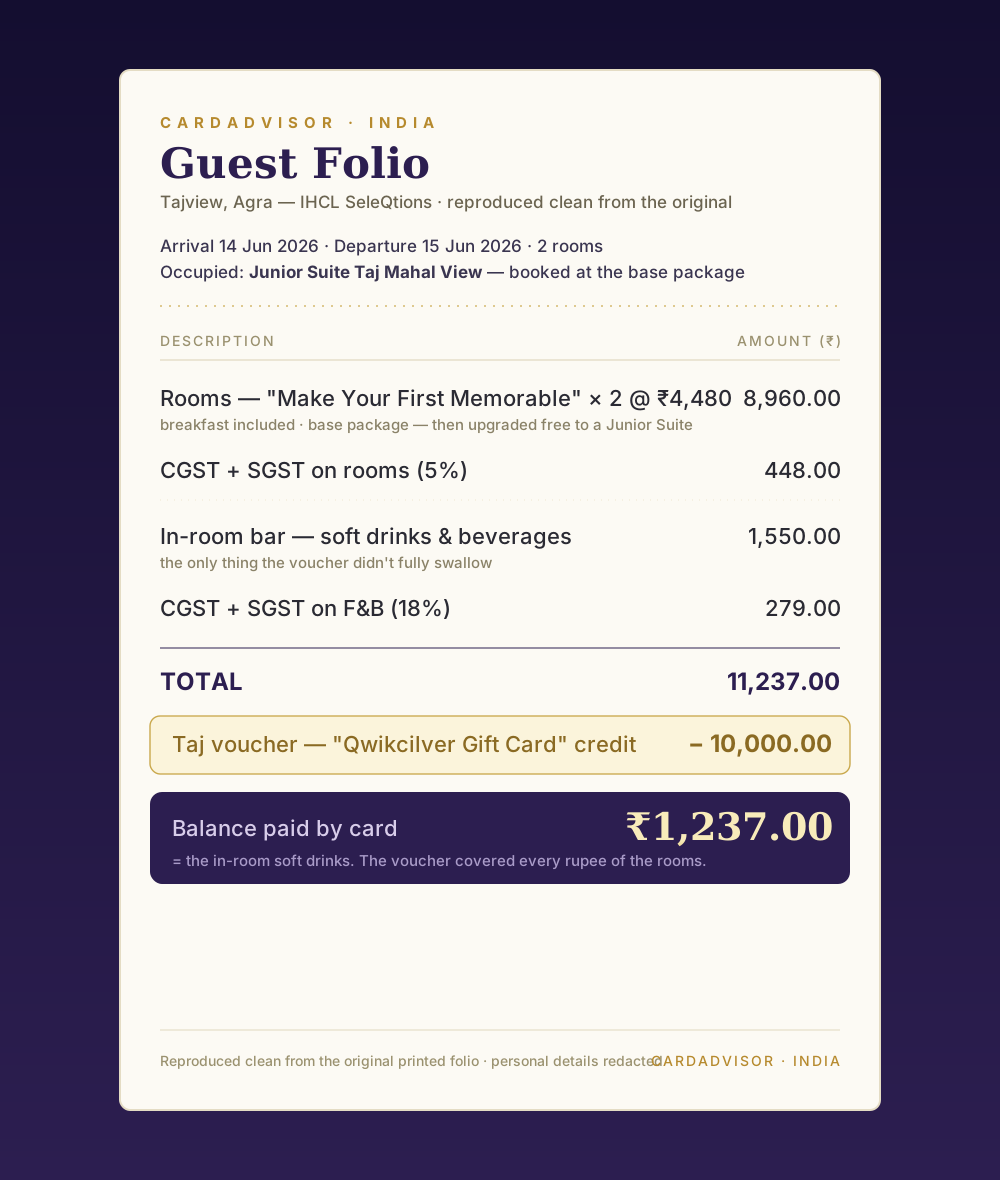
| Line | Amount |
|---|---|
| Two rooms — "Make Your First Memorable" package, breakfast incl. (₹4,480 each) | ₹8,960 |
| Room GST (5%) | ₹448 |
| In-room soft drinks & beverages | ₹1,550 |
| Beverage GST (18%) | ₹279 |
| Total folio | ₹11,237 |
| Less: Taj voucher (the "Qwikcilver gift card" line) | −₹10,000 |
| Paid by card | ₹1,237 |
| What we actually occupied — 2× Junior Suite Taj Mahal View @ ~₹17,000 | ~₹34,000 of suite |
Look closely at what the ₹10,000 voucher did: it swallowed the entire room cost (₹9,408 including tax) and nearly ₹600 of the drinks. The ₹1,237 I actually paid wasn't the hotel — it was, almost to the rupee, the soft drinks we'd put away in the room. Three things make this the mirror image of the cheap-ibis stay, and all three are worth saying plainly:
- The voucher was already-spent money — and dying. I'd earned it from spending I'd have done anyway, and it was about to hit zero. Redeeming it isn't a cost, it's a recovery: the difference between getting ₹10,000 of value and getting nothing. The rooms cost me no cash at all; the entire out-of-pocket for the trip was ₹1,237 of soft drinks — which, for two Taj-Mahal-view suites, is a rounding error I'm happy to own.
- I paid base-room money and lived a suite life. ₹8,960 of rooms — fully covered by the voucher — came with a stay the hotel was otherwise selling for ~₹34,000. That's not a discount, it's a 3.8× multiplier on the rooms I actually booked — and I got it precisely because I booked the cheap room and left headroom for the upgrade to land.
- The premium part was free. This is the bit the Accor piece deliberately avoided and this one embraces: the marble, the view, the suite — none of it cost me a rupee or a single extra voucher. The hotel gave it away. You cannot engineer a guaranteed upgrade, but you can book the way that makes one possible, and then be the kind of guest one is easy to hand to.
Could I have "spent" the voucher more aggressively — booked the suite outright and topped up the rest in cash? Sure. And I'd have paid ₹20,000-plus in cash for the privilege of pre-buying an upgrade I got for free. That's the trap. The voucher does its best work at the bottom of the price list, not the top.
The hidden Taj tricks nobody puts in the brochure
If you remember nothing else, remember these. This is the actual value of the article.
- Treat a voucher as a melting ice cube, not a savings account. 360 days, no extension, zero value at expiry. Don't wait for the perfect trip — book a good trip before the clock runs out. An expiring voucher used "merely well" beats a perfect plan that lapses.
- Book the base room, not the suite. It's where the voucher stretches furthest and it's the only way to leave yourself room to be upgraded. Book the top and you've spent the upside before check-in.
- For a voucher booking, call the travel desk — and you'll often find it's cheaper anyway. You have to call to use the voucher, but the bonus is real: in my case the desk quoted a lower rate than the website and the Tata Neu app for the same room and night. The app is a vending machine; the desk is a person with discretion and a better price.
- Say it's a voucher, and say where it's from, on the first call. "This is the Amex Platinum Travel Taj voucher" up front saves a tangle at payment. Then reply to the payment-link email confirming voucher settlement — that's what locks it.
- Link your NeuPass / Taj InnerCircle number — even when booking by phone. It's free to join and member benefits are honoured on desk bookings; status is a big input into who gets upgraded. Don't leave it off the file because you didn't book online.
- Answer the "any occasion? early check-in?" questions like a human, and forgive the hotel when availability bites. Early check-in is a courtesy, not a right; the night I arrived the hotel was full and couldn't oblige. Meeting that with grace — and having given them a warm, real picture of your trip — is exactly the soil a surprise double upgrade grows in.
So… was it worth it? And who should copy this
Let me be honest about what this is and isn't, because credibility is the whole point of this site.
The headline — ₹34,000 of suite for an expiring voucher and ₹1,237 of soft drinks — is real, but two-thirds of it (the upgrade) is not something you can bank on. You can't promise yourself a double suite bump; I can't either. What you can control is the part that made it possible: an expiring voucher spent before it died, on a base room, through the desk, with status on the file. Do that every time and the upgrades will find you often enough to matter — and even when they don't, you've still recovered ₹10,000 of dying voucher into a genuine Taj stay. There is no version of this where you lose.
Copy this if: you hold a card that throws off a Taj voucher (the Amex Platinum Travel being the obvious one), you've got an expiry creeping up, and you'd rather convert "use-it-or-lose-it" credit into a real family memory than watch it evaporate. The playbook is boring and repeatable: base room, travel desk, loyalty number, warmth.
Skip the over-thinking if: you're tempted to hoard the voucher for some mythical perfect trip. There isn't one. The clock always wins. A good-enough trip you actually take beats a perfect one you plan past the expiry date.
If you want the earning side — whether the Amex Platinum Travel still makes sense after the 2026 milestone cut, and exactly how much you now have to spend to see that voucher — it's all in my Amex Platinum Travel review. And if you want the opposite philosophy in action — squeezing maximum nights out of the cheapest room instead of luxuriating in the most expensive — that's the ibis Jaipur points stay. Two ends of the same idea: pay almost nothing, and make sure the "almost nothing" is doing exactly the job you want.
More redemption diaries
This is one half of how I actually travel — turning credit-card by-products into real stays. Its companion pieces:
- The cheapest Accor stay I've made in India — the opposite philosophy: four nights at an ibis, the whole bill cleared in points, ₹0 cash.
- Amex Platinum Travel review (2026) — the card behind this voucher, and whether it still earns its keep after the milestone cut.
More to come — including the Taj loyalty tiers and how to climb them without overspending.
Written from my own stay at Tajview, Agra – IHCL SeleQtions, in June 2026. Room rates and the suite valuation reflect what the hotel was quoting for my dates; your prices will differ. Upgrades, early check-in and late checkout are subject to availability and hotel discretion — nothing here is contractual. Independent and informational, not financial advice — and very much not sponsored by the kind people at the front desk who bumped us upstairs.

I have spent over a decade on Indian credit cards, mostly for the points and miles. I am a software engineer by profession, I hold and use the cards I write about, and I redeem through airline and hotel transfer partners: Avios, KrisFlyer, Flying Blue, Air India Maharaja Club, Accor ALL, Marriott Bonvoy and Taj. What I write about is what a card is actually worth after the fine print, the caps and exclusions that decide the real return, and the changes issuers make quietly. No paid placements.
Frequently asked questions
How do you book a hotel with an Amex Taj voucher?
How long is the Amex Platinum Travel Taj voucher valid?
Should you book the cheapest room and hope for an upgrade?
Do Taj loyalty (NeuPass / Taj InnerCircle) benefits apply if you book through the travel desk?
Is the upgrade and early check-in guaranteed at Tajview Agra?
Is Tajview Agra worth it for a family trip?
More guides
Researched from primary sources. How we review →
Independence. CardAdvisor is an independent editorial publication. We are not affiliated with, endorsed by, sponsored by, or authorised to act for American Express. All issuer names, product names, and payment-network marks are the property of their respective owners and appear here for identification and comparison only. Card faces shown on this site are our own original illustrations — we do not display or host issuer card artwork or logos.